Table Of Content

Taking the pen name Mark Twain, Samuel Clemens wrote his most famous novels in this house, including The Adventures of Tom Sawyer and The Adventures of Huckleberry Finn. On a bustling city street in downtown Hartford, Connecticut, the Mark Twain House & Museum offers a vibrant, intimate look at the Clemens family during some of their happiest days. Children between the ages of 2 and 6 are welcome on the hour-long tour; in fact, they get in free! However, a parent with a loud or disruptive child may be asked to leave the tour if the noise is detracting from the experience for others.
Conservatory and Turret - Mark Twain House
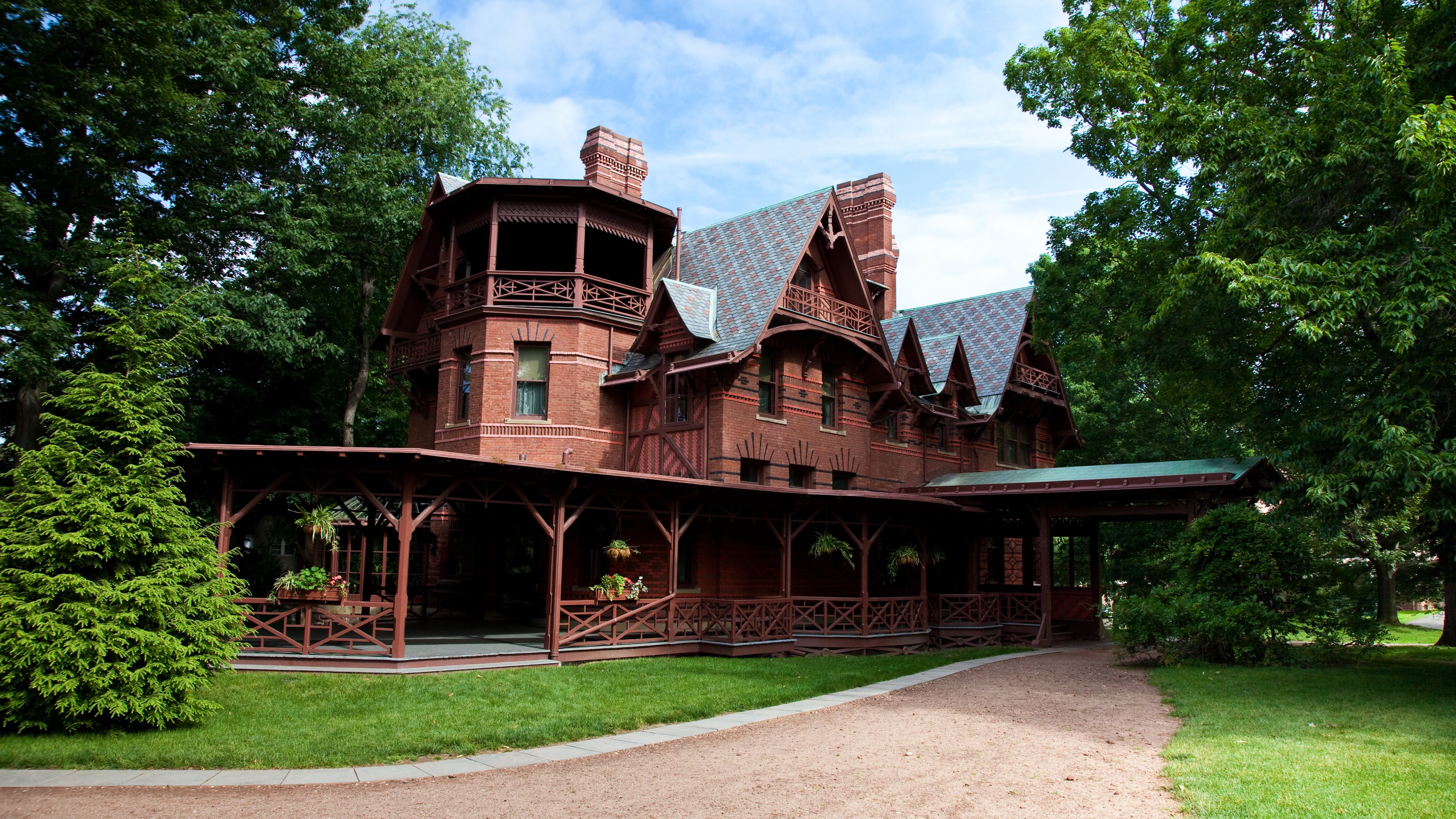
However, the patterned surfaces, ornamental trusses, and large decorative brackets are characteristics of another Victorian style known as Stick. But, unlike most Stick Style buildings, the Mark Twain house is constructed of brick instead of wood. Some of the bricks are painted orange and black to create intricate patterns on the facade. Their home measures 11‚500 square feet‚ and has 25 rooms distributed through three floors.
The Extended Beecher Family Inhabits Nook Farm
Collections include some 50,000 items belonging to the author and his family. Offered daily, our living history tours are an immersive experience that allow you to explore a slice of life in the Clemens household. Meet the family and friends that shaped Mark Twain’s day to day life and celebrate the hardworking servants that kept the household running, ask questions face to face, and hear their stories in their own words. Led by an actor portraying a member of the household, each tour is about 70 minutes and includes opportunities not available on a general house tour. The twenty-five-room Gothic Revival, “stick-style” mansion mimicking exposed framing is a National Historic Landmark. The massive house is 11‚500 square feet and has 25 rooms on three floors.
Wild Life: Synchronized Coral Spawning
In between the two venues is Olana, Vaux's Persian-inspired design built in 1872 in Hudson, New York. Note how architect Edward Tuckerman Potter uses a variety of architectural detail to make the Mark Twain House visually interesting. The house, built in 1874, is constructed with a variety of brick patterns as well as brick color patterns. Adding these decorative brackets in the cornice creates as much excitement as a plot twist in a Mark Twain novel.
Timeline
Yet the design continues to astonish visitors to staid Hartford, Connecticut, long known as "the insurance capital of the world." The similarities are striking, with colored bricks and stenciling inside and out. In architecture, the popular is usually what gets built and surely it's what gets adapted by the eager architect. Perhaps Vaux himself was familiar with the Nott Memorial in Schenectady, the domed structure Potter designed in 1858. Edward Tuckerman Potter, the design architect of the Mark Twain House, would have known about Olana, the Hudson River Valley mansion that architect Calvert Vaux was building for painter Frederic Church. Potter's architecture practice was centered in his hometown of Schenectady, New York, and the Mark Twin House was built in 1874 in Hartford, Connecticut.
Please note the museum is closed on Easter Sunday, July 4th, Thanksgiving Day, December 24, December 25, and January 1.
Harriet Beecher Stowe Center
The facade’s red brick masonry features stringcourses and other decorative patterning made from black- and vermilion-colored brick. The building is crowned with a patterned, tricolor slate tile roof and four chimneystacks featuring the same polychrome brickwork as the rest of the house. The Clemens family later added a servants’ wing on the northwest side.
Tours may not be suitable for some very young children.
Yana Razumnaya Success Story - Advocates' Corner - CT.gov
Yana Razumnaya Success Story - Advocates' Corner.
Posted: Sat, 13 Apr 2024 20:19:56 GMT [source]
The overhanging eaves, brackets, and second-story balcony may be slightly more modest than the author's home, but the elements are there for Twain's beloved coachman, Patrick McAleer. From 1874 until 1903, McAleer and his family lived in the Carriage House to serve the Clemens family. Tours include the restored kitchen wing and butler’s pantry, allowing visitors to experience the rooms as the Clemens' servants did. The modern, LEED certified museum center features orientation and changing exhibition galleries, a Ken Burns documentary and The Nook Café, serving sandwiches, salads and other light fare. The Mark Twain House & Museum is pleased to welcome visitors through our Library Membership Program. A library membership pass is available, in partnership with local libraries, to offer patrons discounted admission to the museum.
In September the family – now with the addition of baby Clara – moved into the house, beginning a period of 16 years that both Mark and Livy considered their happiest, and the world in general sees as Mark Twain’s most productive. Life there has been recorded by the author himself in his lively memoir “A Family Sketch” and in multiple pages of his autobiography. While a small group of us waited for our official tour to start, we idled through a small museum across the hall. It contains an old printing press machine Twain invested in, some typesetting and letterpress equipment and his old desk. The museum displays various items like his glasses, pipes, tin boxes, and writing utensils. The Mark Twain House and Museum in Hartford, Connecticut, was his home from 1874 to 1891.
I stopped at the homes of many writers including Flannery O’Connor, John Steinbeck, Edgar Allan Poe and others, and this wasn’t to be missed. Aside from being a prolific and beloved author, I admire Twain for his love of travel, innovation and dry observations of humanity. The community’s end came, in large part, with Twain’s departure to Europe in 1891, when financial problems forced him to close the house. Both Twain and Stowe’s homes, and part of the Nook Farm estate, have since become national landmarks.
This freely available resource empowers the public with authoritative knowledge that deepens their understanding and appreciation of the built environment. The long room, with its plant-filled glass conservatory at one end, is overlooked by a vast carved chimneypiece Here the Clemenses would enjoy a light supper after a trip to New York, or play with the kids, or read quietly. Or, as daughter Susy described, Papa would read his manuscripts aloud and Mama took the opportunity to “expergate” them; or, as daughter Clara described, Papa would make up tales using the bric-a-brac on the mantel. But here in Hartford is a wonderful chimera of a house, surmounted by Elizabethan chimneys and dotted with balconies.
Mark Twain lived here for almost twenty years and some of his best-known works, including Tom Sawyer and Huckleberry Finn, were actually written in this house. Nook Farm’s other Beecher family connections included Mary Beecher Perkins, married to lawyer Thomas Clap; and Harriet Foote, a cousin to the Beecher sisters, whose husband was Joseph Roswell Hawley. Hawley was a North Carolina native who came north to attend college, became an editor of The Hartford Evening Press and then The Hartford Courant when the two newspapers consolidated.
The picturesque, historicist design of the exterior concealed the fact that the house’s amenities were quite modern. It featured gas lighting and a total of seven bathrooms with running water and flush toilets. The billiard room on the third floor also served as the author’s office and study. The Webster Bank Museum Center at the Mark Twain House & Museum is always your first and last stop as it houses our ticket counter, museum store, film, and café. All tours gather in the museum center before heading over to Mark Twain’s historic 1874 home.
Proceeds from the store support the upkeep and restoration of Twain’s historic home and its programs. It includes over 200,000 items of art, furniture, memorabilia, manuscripts and visual media to illustrate Stowe’s life. During his lifetime, he’d lost a toddler son, two daughters and his wife. In his final years, he sold this house, where he’d spent his happiest years and moved into something smaller elsewhere in Connecticut. Then, in 1910, Halley’s Comet returned after seventy-four years, and Twain departed to meet it again.
Tours enter the house from the porte-cochere into a darkish entry hall whose lighting, meant to imitate the subtlety of gaslight, reflects a profusion of silvery stencil on the walls – a careful reproduction of Tiffany’s and his crew’s décor. Her father, Jervis Langdon, a wealthy coal and timber magnate of Elmira, had given the newlyweds a house in Buffalo. But a combination of tragic events – the deaths of Jervis, and then of a friend of Livy’s – and a general dissatisfaction with Buffalo got the couple thinking of Hartford. To this day, classic Victorian conservatories add value, charm, and stature to a home. Check them out online, like Tanglewood Conservatories, Inc. in Denton, Maryland.
The house became a boys’ school and then an apartment building before being rescued in 1929 by the Friends of Hartford, which established the Mark Twain Memorial and Library Commission to restore the house to its original appearance. Arriving by BusCT Transit buses 60, 62, 64, and 66 connect The Mark Twain House & Museum with downtown Hartford and West Hartford Center. A transit shelter is located adjacent to the museum at Farmington Avenue and Woodland Street. Ghost tours are offered seasonally and are available by reservation only.


No comments:
Post a Comment